 1
 2
 3
 4
 5
 6
 7
 8
 9
10
11
12
13
14
15
16
17
18
19
20
21
22
23
24
25
26
27
28
29
30
31
32
33
34
35
36
37
38
39
40
41
42
43
44
45
46
47
48
49
50
51
52
53
54
55
56
57
58
59
|
/**
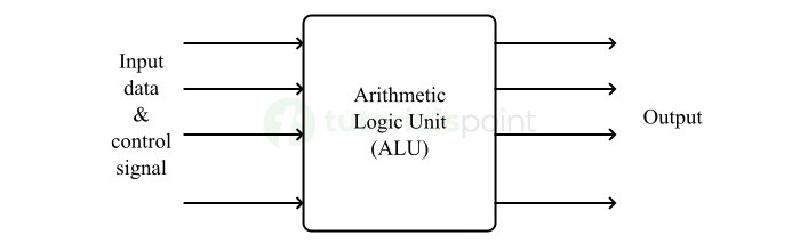
 * ALU (Arithmetic Logic Unit):
 * Computes out = one of the following functions:
 *                0, 1, -1,
 *                x, y, !x, !y, -x, -y,
 *                x + 1, y + 1, x - 1, y - 1,
 *                x + y, x - y, y - x,
 *                x & y, x | y
 * on the 16-bit inputs x, y,
 * according to the input bits zx, nx, zy, ny, f, no.
 * In addition, computes the two output bits:
 * if (out == 0) zr = 1, else zr = 0
 * if (out < 0)  ng = 1, else ng = 0
 */
// Implementation: Manipulates the x and y inputs
// and operates on the resulting values, as follows:
// if (zx == 1) sets x = 0        // 16-bit constant
// if (nx == 1) sets x = !x       // bitwise not
// if (zy == 1) sets y = 0        // 16-bit constant
// if (ny == 1) sets y = !y       // bitwise not
// if (f == 1)  sets out = x + y  // integer 2's complement addition
// if (f == 0)  sets out = x & y  // bitwise and
// if (no == 1) sets out = !out   // bitwise not

CHIP ALU {
    IN
        x[16], y[16],  // 16-bit inputs
        zx, // zero the x input?
        nx, // negate the x input?
        zy, // zero the y input?
        ny, // negate the y input?
        f,  // compute (out = x + y) or (out = x & y)?
        no; // negate the out output?
    OUT
        out[16], // 16-bit output
        zr,      // if (out == 0) equals 1, else 0
        ng;      // if (out < 0)  equals 1, else 0

    PARTS:
    Mux16(a=x,b=false,sel=zx,out=x1);
    Not16(in=x1,out=negateX);
    Mux16(a=x1,b=negateX,sel=nx,out=x2);

    Mux16(a=y,b=false,sel=zy,out=y1);
    Not16(in=y1,out=negateY);
    Mux16(a=y1,b=negateY,sel=ny,out=y2);

    Add16(a=x2,b=y2,out=xPlusy);
    And16(a=x2,b=y2,out=xAndy);
    Mux16(a=xAndy,b=xPlusy,sel=f,out=fxy);

    Not16(in=fxy,out=notFxy);
    Mux16(a=fxy,b=notFxy,sel=no,out=out,out[15]=ng,out[0..7]=outCopy1,out[8..15]=outCopy2);

    Or8Way(in=outCopy1,out=allZero1);
    Or8Way(in=outCopy2,out=allZero2);
    Or(a=allZero1,b=allZero2,out=sel);
    Mux(a=true,b=false,sel=sel,out=zr);
}
|
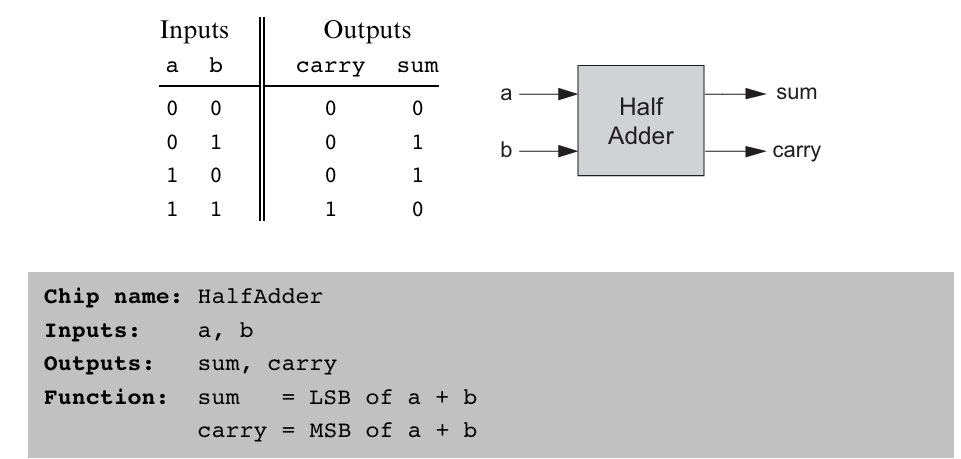 经过观察,carry符合AND门的输出规律,sum符合XOR门的输出规律。调用原有API即可。